Contributors: Jennifer Tomasik, SM, FACHE and Daphnie Pierre, MBA
To learn more about Jennifer and Daphnie, click here.

Source: Bigstock |
Healthcare leadership transitions have been on the rise, and it is likely the trend will continue. AMN Healthcare’s leadership survey indicates that nearly 66% of respondents intend to seek a new leadership position within the next twelve months.1 Leadership transitions are critical moments in any organization's lifecycle, yet nearly half of them fail.2 How organizations prepare for and manage leadership transitions can either propel the organization forward (if handled well) or lead to significant setbacks (if handled ineffectively).
Often, transitions focus exclusively on the search for the leader, sometimes extending to the onboarding process. While the search and onboarding are critical, we find that the most effective leadership transitions take a more holistic approach to help stabilize the organization, maintain employee morale, and drive long-term success. This approach takes a systems lens, thinking not only about the new leader but also an assessment of the organization and its readiness for the transition.
This article explores five key stages of building towards a successful leadership transition.
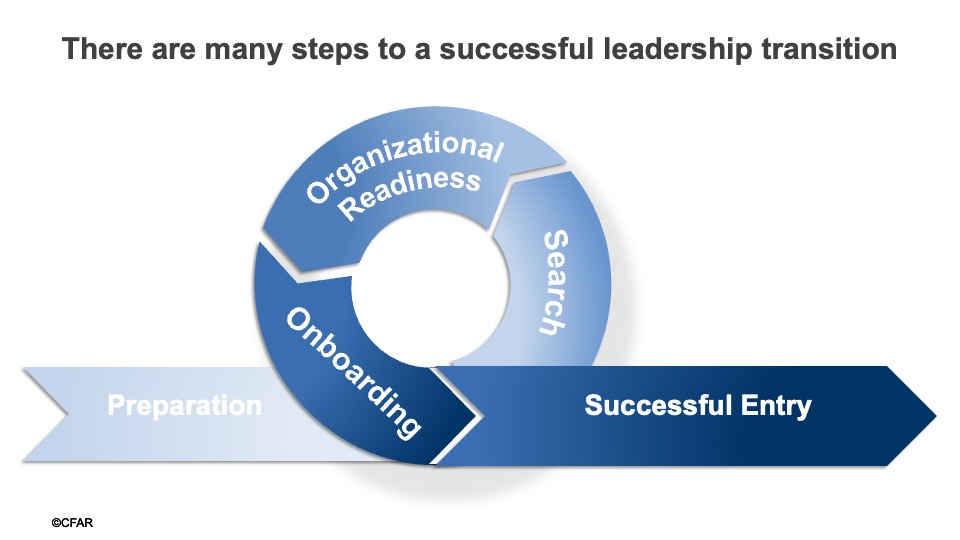
Stage 1: Preparation
Communicate Vision and Expectations
Being clear about the process, timeline, and stakeholder involvement and continuously communicating expectations for the transition process is key to maintaining transparency and trust during what can be an anxious time for the organization.
Assess the Strategic and Organizational Context
Leadership transitions are closely intertwined with strategy. The strategic direction and the characteristics and skills needed to advance the desired future state should inform the development of the job profile, search process, and selection of the organization’s next leader.3 It is important to consider:
- To what extent is the board aligned on the future vision and strategy?
- How willing and to what extent is the board prepared to shift direction?
- Are the board, leadership team, and staff on the same page about:
- the organization’s most important strengths
- significant challenges and opportunities facing the organization
- the potential risks inherent in transitions?
- What might be needed in a new leader?
Who informs the answers to these questions is also important. Organizations will have different norms and expectations about how wide a net to cast. For instance, a health system may invite the board and key leaders to weigh in, while a health foundation may want to include its staff, community partners, grantees, and others. Consider external stakeholders who can be “friendly skeptics” who know enough about the organization to share helpful insights about both the incoming leader and the organization as it prepares for entry.
Perhaps the most important (and often missing) part of the assessment is using it to ensure the board has a shared point of view about what is needed to move forward. If individual board members have different ideas about what is important in a new leader or the needs of the organization, it becomes difficult to align on a candidate and fully prepare the organization to welcome its next leader.
Stage 2: Conduct the Search
It is just as important to choose the right search firm as it is to select the right leader. We often support the search committee to develop and manage the process of evaluating and selecting search firms to find the best fit.
Once selected, the search firm can use the data gathered from the organizational assessment to define the role and responsibilities, creating a detailed job description and search strategy. This strategy should include a process for evaluating candidates to ensure they align with the organization’s values and strategic needs.
Stage 3: Consider Organizational Readiness
As the search is conducted, part of ensuring the success of the leadership transition is, as one of our clients said, “readying the house for sale.” This process goes deeper than removing clutter and staging furniture — it peels back the curtain and explores any findings around talent, organizational structure, culture, and operations. This process should lead to an implementation plan for matters that could be resolved before the incoming leader’s entry, what matters should benefit from their thinking and input upon entry, and what can be addressed later. It is critical the implementation plan be oriented to helping leaders and staff anticipate and guide change, as opposed to articulating operational steps alone.
Stage 4: Develop an Onboarding Plan
A well-crafted onboarding plan considers the organization's needs and the incoming leader's preferences for learning about the organization. The goals set for onboarding should guide what to include in onboarding manuals — information and experiences that will be most impactful, such as unit descriptions, priorities, and key conversations — and who will be responsible for which parts. Up to this point, the board would have largely been managing the search process, but it will now need more support from the leadership and staff to implement the onboarding plan.
Stage 5: Empower and Support the New Leader for a Successful Entry
Align on Metrics of Success
To empower the new leader, it is crucial to establish a way for the board to evaluate the new leader’s progress and provide feedback and support. This helps set clear expectations and provides a roadmap for the new leader's initial months on the job.
Develop a Transition Plan
The final stage of the process is developing and preparing to implement a transition plan that outlines key activities and priorities for the first year. We sometimes break the plan into the first 30 days, 90 days, six months, and 12 months. It will be important to consider the objectives of the transition plan, which will ensure success for the new leader and the organization. Those preparing the plan, in partnership with the incoming leader, might consider:
- What should be the balance of time spent on different priorities?
- How much time should be spent internally before venturing outside of the organization?
- What relationships should be prioritized, and who should maintain them?
Effective leadership transitions require careful planning, communication, and support throughout the process. By following these five stages, organizations can set themselves up for success during leadership change.
Contact Jennifer at: [email protected]
Contact Daphnie at: [email protected]
For more information on this topic or related materials, contact CFAR at [email protected] or 215.320.3200 or visit our website at www.cfar.com.
References
- AMN Healthcare, 2024 Outlook for Leadership Candidates, May 14, 2024.
- Scott Keller, “Successfully Transitioning to New Leadership Roles,” McKinsey & Company, May 23, 2018.
- Thomas North Gilmore, “The Importance of Linking Leadership Succession, Strategy, and Governance,” Non-Profit Quarterly, September 2012.